Hanoi Iron and Steel (HSV) - The Ministry of Industry and Trade has just sent report No. 2152/BCT-CN to the Prime Minister on the proposal to build a "Strategy for development of Vietnam's steel industry until 2030, vision to 2050".
Accordingly, the Ministry of Industry and Trade believes that there needs to be specific policies to help further develop the steel industry.
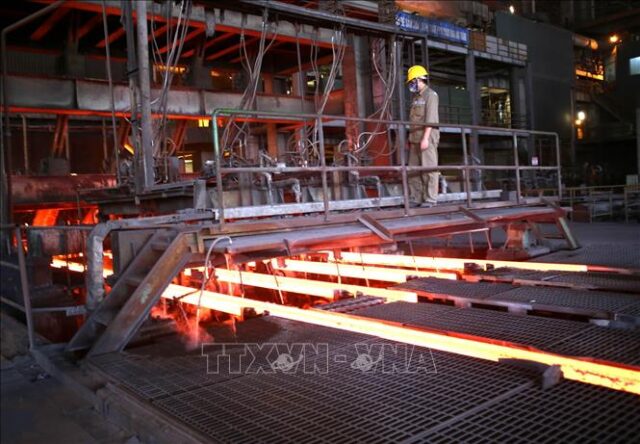
The Ministry of Industry and Trade said that by 2021, steel billet production capacity is 27 million tons/year; of which hot rolled steel coil (HRC) is 7-8 million tons/year.
In addition to a number of newly built factories with large capacity such as: Hoa Phat Dung Quat Iron and Steel Complex, Hung Nghiep Formosa Iron and Steel Complex, Nghi Son Steel, the remaining steel billet factories mainly have small capacity and outdated equipment.
Steel production capacity is still limited, currently mainly products cannot provide enough steel demand for the entire economy; Especially alloy steel, Vietnam has not yet produced special types of steel.
The competitiveness of Vietnam's steel industry is considered by the Ministry of Industry and Trade to be quite low when most of the input materials for steel production must be imported. Besides, there still exist factories with small capacity, outdated equipment, energy consumption and environmental risks.
"Vietnam's steel industry basically depends on imported raw materials such as iron ore, scrap steel, coking coal, graphite electrodes... so when the price of input materials fluctuates, the price of domestic finished steel products must also be adjusted according to the world market," the representative of the Ministry of Industry and Trade emphasized.
It is expected that in 2022, Vietnam will have to import many types of raw materials to produce steel such as iron ore for blast furnaces about more than 18 million tons, scrap steel about 6-6.5 million tons for electric furnaces, coking coking coal about 6.5 million tons and graphite electrodes about 10,000 tons... with forecasts that the price of iron ore, scrap steel, raw ore and coking coal... will remain at a high level, which will directly affect manufacturing enterprises. steel and domestic steel market.
Looking at the recent development process, according to the Ministry of Industry and Trade, in the period 2016-2021, the steel industry has had rapid development but there has been an imbalance between upstream and downstream development. Post-steel products such as galvanized steel sheets and steel pipes grew well in production and export value.
Meanwhile, alloy steels, especially HRC - necessary input materials for many industries such as cold rolled steel (CRC) production, galvanized steel, steel pipes, shipbuilding, and mechanical engineering are in great demand, but domestic production capacity does not meet the demand, leading to continued imports in large quantities.
In the long term, to ensure the domestic demand for HRC and alloy and high-quality steel, it is necessary to continue to attract and invest in a number of large steel production complexes to serve domestic demand, gradually reducing dependence on imported steel.
According to the Ministry of Industry and Trade, industrialization is first of all determined by the rapid and sustainable development of foundation industries, especially processing and manufacturing industries.
The steel industry provides the most important input materials for production and manufacturing industries, especially industries such as mechanical engineering, shipbuilding industry, automobile and motorbike manufacturing, household appliance manufacturing, defense industry, mining industry, electrical industry...
Therefore, autonomy in domestic steel production is an indispensable requirement for autonomy in raw materials to serve production and consumption of the people, as well as the process of urbanization and modernization of national facilities.
Preliminary forecasts, the total market demand of Vietnam's manufacturing industries in the period to 2030 may reach 310 billion USD; Of which the market demand from mechanics serving industrial projects is 120 billion USD; construction mechanics, agriculture, and processing is 15 billion USD; Rail transport is 35 billion USD, subway is 10 billion USD and automobile is 120 billion USD. This will be a huge market for the domestic steel industry, especially manufactured steel and high quality alloys...
Affirming that the steel industry plays a particularly important role in the country's development process towards industrialization and modernization, the report signed by Minister of Industry and Trade Nguyen Hong Dien clearly states: at the present time, there is no specific, separate policy to promote and orientate the development of the steel industry.
After the steel industry planning was abolished according to the provisions of the 2017 Planning Law and price control was also removed from the list of controlled goods according to the provisions of the 2012 Price Law, the State did not have tools, so it was difficult to ensure state management of the steel industry, unable to manage production capacity, balance supply and demand of domestic steel industry products to provide raw materials, promote key industries as well as ensure infrastructure development in a modern direction. modernization.
For the steel industry to develop sustainably and stably, the State needs to develop policies strong enough to promote the development of steel industries to create a basic foundation for modern and sustainable industrialization.
The Ministry of Industry and Trade outlined a more detailed development direction such as: to accelerate the process of industrialization and modernization of the country, Vietnam needs to have policy directions to strongly develop the metallurgy and materials industry, especially steel processing and manufacturing.
Firstly, with the HRC category: in the coming period, it is necessary to develop and invest in more large production projects. This type of war steel has a large proportion in the manufacturing and processing industry.
Second, with alloy steel and especially serving the mechanical industry, Vietnam needs to build large-scale metallurgical complexes; which focuses on the production of technologically advanced processing steels with a large market capacity to initially master the production technology of basic manufacturing processing steels.
The Ministry of Industry and Trade also mentioned the issue of the state having preferential policies on land, infrastructure, science and technology and human resource training to encourage and promote the development of steel projects to form a strong development of the metallurgical industry, meeting the process of industrialization and modernization of the country.
Source: https://baotintuc.vn/lanh-te/can-chinh-sach-dac-thu-de-phat-trien-nganh-thep-20220509111537196.htm