
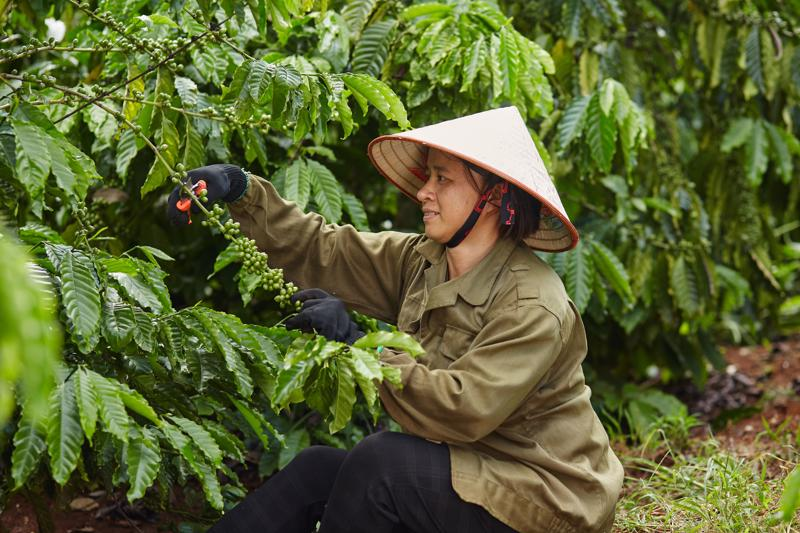
(HSV VIETNAM GROUP) – Vietnam aims to develop farming into a complete, professional economic and technical sector with highly competitive products. At the same time, exporting products from fruit, rice, cashew, wood... will reach over 26 billion USD in 2030.
Vietnam aims to build and develop strong coffee brands.
Deputy Prime Minister Tran Luu Quang has just signed Decision No. 1748/QD-TTg approving the Crop Development Strategy until 2030, with a vision to 2050.
The general goal of the Strategy is to develop farming into a complete, professional, technical economic sector with highly competitive products, ensuring food safety, solidifying national food security and other needs of the economy, increasing export value; effectively use resources, protect the ecological environment, effectively prevent and combat natural disasters and adapt to climate change, create jobs, improve income and quality of life for farmers, contributing to social stability and ensuring national defense and security.
KEEPING RICE-CULTIVATED LAND AREA STABLE
Accordingly, by 2030, the average growth rate of crop production value will be 2.2 - 2.5%/year; The average growth rate of value added in the crop processing industry is 8-10%/year.
Along with that, the proportion of production area practicing good agricultural practices (VietGAP and equivalent...) is 10 - 15%, organic farming is 1%. The percentage of value of crop products produced in forms of cooperation and association reaches 30 - 35%. Export turnover of crop products reached over 26 billion USD. The average product value per hectare of cultivated land reaches 150 - 160 million VND.
By 2050, farming will become a modern technical and economic industry among the top in the region and the world. Horticulture products are produced according to high-tech agriculture, organic agriculture, food safety and environmental friendliness. Vietnam is a deep processing center of world agriculture.
Regarding the development orientation of a number of key crops, the strategy determines the development of rice production in centralized planning areas with synchronous investment in transportation, irrigation, and logistics infrastructure. Stabilize the area of 3.56 million hectares of rice cultivation land. Of which, there is 3.0 million hectares of land dedicated to wet rice cultivation, with an output of over 35 million tons of rice, serving as the core to ensure national food security, meeting the needs of consumption, processing, storage and export. Of which, high quality, specialty rice accounts for 85 - 90%, rice used for processing accounts for 10 - 15%.
BUILDING AND SUSTAINABLE DEVELOPMENT OF KEY AGRICULTURAL PRODUCTS
In fact, for many years, agriculture has played an important role as a foundation for the economy. Last year, in the context of the country's export facing many difficulties, agricultural products still had an impressive year of growth.
In 2023, although agricultural, forestry and fishery exports will not reach the target of 54 billion USD, in fact the whole year of 2023 will only reach 53.01 billion USD, but the trade surplus will reach a record of 12.07 billion USD, an increase of 43.7%, accounting for over 42.5% of the country's trade surplus. Six items with an export value of over 3 billion USD include coffee, rice, vegetables, cashew nuts, shrimp, wood and wooden products.
The strategy for developing farming to 2030, with a vision to 2050, specifically focuses on promoting the strengths of farming and exploiting maximum advantages for Vietnam's key agricultural products.
Accordingly, reorganize production and form concentrated key fruit production areas on the basis of promoting the potential and advantages of ecological regions, associated with the development of processing factories and consumer markets. Prioritize the development of a number of advantageous fruit trees with consumer markets such as mango, banana, dragon fruit, pineapple,...
Besides, for vegetable production and growing, on the basis of promoting the advantages of land, water resources, and climate to increase the area and diversify types and seasons to meet the rapidly increasing consumer demand domestically and for export. Build clusters linking production with processing and consumption of vegetables in localities and regions with large vegetable output. Develop safe vegetable production areas, focusing on ensuring traceability of origin.
On the other hand, for coffee, continue to promote replanting, grafting and renovation by 2025 to reach 107 thousand hectares of coffee with new high-yield, high-quality varieties; develop specialty coffee by 2030 with an area of 11,500 hectares and an output of about 5,000 tons. Promote processing and diversification of coffee products, especially deep processing to add value and create a difference in Vietnamese coffee associated with building and developing the Vietnamese coffee brand.
For pepper, focus on managing the development scale in accordance with market demand. Reducing a part of the unsuitable area for growing pepper, old and seriously diseased pepper area to other more effective crops. Research, select, create and transfer disease-free pepper varieties with productivity, quality and resistance to pests and diseases, and build a variety structure suitable for the consumption market for each ecological region. Prioritize intercropping solutions to improve economic efficiency.
Along with that, stabilize the cashew growing area, focusing on replacement planting, grafting, renovation and new planting of cashew trees with new, high-yield, high-quality varieties. Synchronously apply technical advances in cashew cultivation such as pruning to create canopy, economical watering, flowering treatment, multi-value exploitation in cashew orchards, intercropping, and intercropping; bringing the average yield to 15 - 17 tons/ha.
At the same time, exploit the potential advantages of land, climate, and labor of sub-regions to develop rubber trees to achieve high economic efficiency in the direction of sustainable development, linking production with processing and product consumption. Intensive farming increases rubber productivity to 1.8 - 2 tons of latex/ha...
Ha Diem HSV