
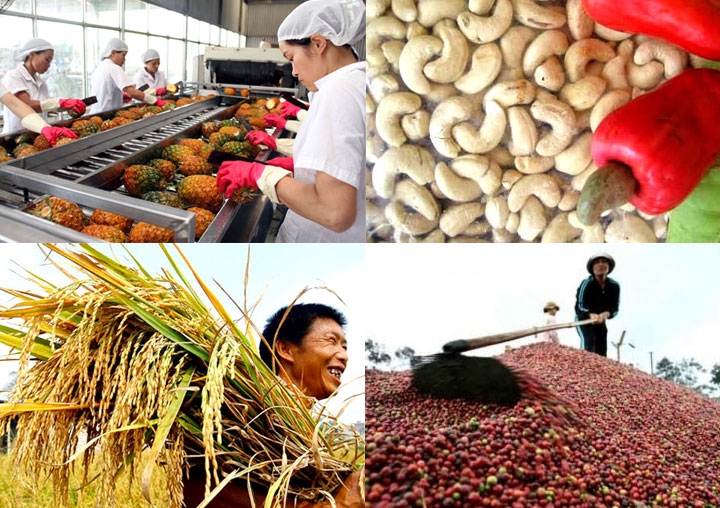
(HSV VIETNAM GROUP) - Delegate Tran Thi Thanh Lam said that most agricultural product profits fall into the pockets of intermediaries who do not directly produce, "with profits of 50-70%, even up to 200%".
At the National Assembly on the afternoon of November 1, Ms. Tran Thi Thanh Lam, standing member of the Social Committee, said that farmers' difficulties in agricultural production "are not a new problem but have never been an old problem, especially in the current period".
When meeting voters, she received many reports about the difficult life of farmers, "extremely high" production input costs while product prices are always modest. She told a story proving that most agricultural profits fall into the pockets of middlemen instead of farmers.
"A Siamese coconut in Ben Tre costs 4,000 VND, but on the market it costs up to 15,000-30,000 VND. Many other agricultural products from farmers' chickens, pigs, and shrimps are similar," she said.
The national target program to build new rural areas has invested in building a lot of infrastructure. But according to her, the two criteria directly related to the lives of rural people are labor and jobs to improve income, "every commune faces difficulties". Even communes that achieve new rural areas have to stagnate in order to pass this criterion. "Is it unfair and unreasonable in the market mechanism for farmers? Is the reason because the State does not have appropriate policies or has policies that have not been promoted in practice", the Ben Tre delegation expressed, saying that agriculture is not only not invested properly but also carries additional burdens from ineffective industrialization and urbanization. Agriculture is identified as the pillar of the industrialization process but farmers, according to her, are losing out.
Ms. Lam cited that in developed countries, profits from industry and services are prioritized for investment in agriculture. Farmers grow rice and raise chickens and pigs but only have to spend a small part of the product price, the rest is invested by the state.
The state needs to have many forms of investment in agriculture such as low-interest loans, infrastructure construction, and market forecasting. Supporting the policy of industrialization and modernization of agriculture and rural areas to shorten the gap with urban areas and improve farmers' lives, Ms. Lam hopes the National Assembly will make reasonable decisions to create conditions for people to stick with agriculture - a solid pillar of the economy in all circumstances.
Ms. Chamaléa Thi Thuy, Head of the Ninh Thuan Provincial Party Committee's Mass Mobilization Committee, also stated that in the most difficult economic times, agriculture is a support option. People can reduce shopping, travel, and tighten spending but still need to eat and use agricultural products.
"But why is it that in a country where the majority of people come from rural areas, have certain experience in agriculture, land resources, and a suitable climate, the quality of agricultural products is not yet highly competitive and does not bring high value? Why is the life of agricultural producers still difficult?", Ms. Thuy asked.
Meanwhile, pressure on consumer prices and children's education costs "burdens the lives of rural people and those working in agricultural production". Deputy Committee for Delegate Affairs Nguyen Tuan Anh assessed that investment in agriculture is still limited. Farmers face many risks when their products cannot be sold or at low prices, so they constantly have to be rescued.
He proposed that the Government evaluate the true causes leading to the above situation to overcome the refrain "a good crop loses prices, a bad crop loses prices", thereby ending the rescues of agricultural products.
Taking durian as an example, Vietnam set a target of 65,000-75,000 hectares in 2020, but it has now reached 131,000 hectares. The area planted with durian increases by 24.5% each year, the highest increase among key crops. The Central Highlands leads the country with 75,000 hectares, followed by the Mekong Delta, Southeast, and Central Coast.
"Experts are concerned that the rush of people in some southern provinces to plant durian trees could lead to disruption of planning, posing many risks when supply exceeds demand. Don't let durian become common durian, the truth is very painful," Mr. Tuan Anh warned.
Ha Diem HSV