
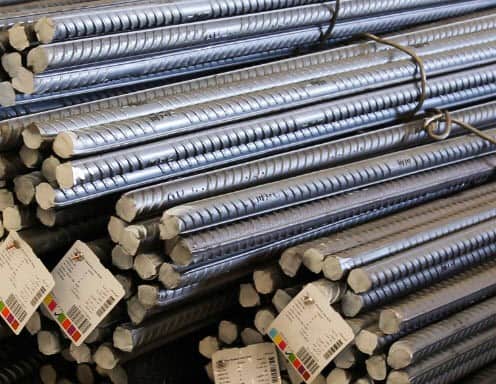
Hanoi Iron and Steel (HSV) - Currently there are too many steel grades on the market and they can easily confuse consumers when choosing.
But the reality is that you don't need to know everything, you just need to pay attention to the most important things to become a wise consumer.
So, what is steel grade? What are the specific meanings of standard parameters on steel grades? What evaluation standards are there and which types are commonly used today?
In this article Hanoi Iron and Steel will share with you everything you need to know.
WHAT IS STEEL GRADE?
Steel grade is a specialized term used to express the strength of steel. In other words, steel grade is the steel's ability to withstand force. It indicates the ability of that steel product to withstand large or small forces.
Commonly used steel grades
With construction steel: SD295, SD390, CII, CIII, Gr60, Grade 460, SD49 (CT51), CIII, SD295, SD390, CB300-V, CB400-V, CB500-V.
With structural steel: In the current Vietnamese market, SS400, Q235, Q345B steel is used, or in drawings we see notes of CCT34, CCT38 steel...
Why are there so many different types of steel?
On the market there are many symbols for steel grades that make consumers confused and do not know which type to use. However, each symbol has its own meaning.
The symbol of a steel grade is associated with the "applied production standards" of that steel. There are many standards that manufacturers apply for production such as Vietnamese standards TCVN, Japanese standards JIS, Russian standards (not as popular)... Each standard will have a different symbol.
Standards applied when producing are: Standards TCVN 1651-1985, TCVN 1651-2008, JIS G3112 (1987) JIS G3112 – 2004, TCCS 01:2010/TISCO, A615/A615M-04b, BS 4449 – 1997.
COMMONLY USED CONSTRUCTION STEEL GRADES
The most commonly used types are SD and CB. So what do these two types specifically mean?
SD symbol on steel grades SD295, SD390, SD490
We often hear people calling steel SD295, SD390, SD490. This is the name according to Japanese standards.
The number behind represents the strength of the steel (in engineering, this is called the yield limit of the steel). For example, SD240 means the steel has a strength of 240 N/mm2.
CB symbol on steel grades CB240, CB300V, CB400V, CB500V
CB is a symbol representing the "durability level" of steel. C stands for grade, B stands for durability.
These names and symbols comply with Vietnamese standards. The number behind (300, 400, 500...) means the strength of the steel (in engineering, people call this the yield limit of steel).
For example, CB300 means steel with a strength of 300 N/mm2. This means that: if an iron bar has a cross-sectional area of 1mm2, it will withstand a tensile or compressive force of about 240N (24kg).
Other symbols and names
According to TCVN 1765 - 75: Steel is denoted by the letter CT, including 3 subgroups A, B, C, of which A is the main one.
Group A: ensures mechanical properties, CTxx, Remove the letter A at the beginning of the steel grade, for example, CT38, CT38n, CT38s are 3 grades with the same σ > 38kG/mm2 or 380MPa, corresponding to 3 different deoxidation levels: quiet, semi-quiet and boiling corresponding to CT38, CT38n, CT38s. For example: CT31, CT33. CT34, CT38, CT42, CT51, CT61…
Group B: ensures chemical composition, regulates ingredients (see handbook). For example, BCT31, BCT33. BCT34, BCT38, BCT42, BCT51, BCT61
Subgroup C: Regulates both properties: mechanical properties and chemical composition. For example: CCT34, CCT38, CCT42 and CCT52
You may want to know: What is concrete grade? Concrete mix norms M150, M250, M300
ACTUAL SYMBOLS OF STEEL TYPES ON THE MARKET
Symbols help consumers identify genuine products.
Steel symbol Ton Nam Kim
For products of the Nam Kim steel brand, the corrugated iron rolls will be covered with packaging printed with the Nam Kim Steel logo.
Southern steel symbol
For rolled steel products of the Southern steel brand, on non-6 or non-8 iron rolls, there is embossed letter VNSTEEL.
Rebar steel has the symbol V, letters and numbers indicating the diameter and steel grade embossed, the repetition distance of these signs is from 1 m to 1.2 depending on the diameter of the steel bar.
Equilateral angle steel has a v symbol on the bar. The steel is embossed with the distance between the two marks being from 1.2 to 1.4m.
Hoa Phat steel symbol
For plain rolled steel, Hoa Phat steel has an embossed logo of three triangles and the word Hoa Phat along with the steel mark used.
For rebar steel, there is an embossed logo of three triangles and the word Hoa Phat along with the type and grade of steel.
Pomina steel symbol
Pomina steel has a characteristic apple symbol followed by steel marks spaced about 1-1.2cm apart. The logo and each number represent the diameter separated by a steel rib.
Viet Nhat steel symbol
Viet Nhat Steel's symbol is the 4-petal flower symbol and has construction steel grades from d10 to d51.
Viet-Uc steel symbol
Viet Uc Steel's symbol is the Kangaroo symbol, with the words V-UC and CB3 steel mark on the steel body.
TABLE OF STEEL GRADES ACCORDING TO STANDARD
WHEN BUILDING A HOUSE AND DOING PROJECTS WHICH STEEL GRADE SHOULD I USE?
In fact, we can use any type of steel. For low-grade steel, we must use thicker steel density and more steel bars per unit area. This leads to uneconomical results. According to experience:
For low-rise buildings (<7 floors): Just use low-strength steel grades CB300 or SD295 (These two types have equivalent bearing capacity).
For high-rise buildings (>7 floors): You should use a steel grade with higher strength, CB400 or SD390. Using even higher strength steel is CB500 or SD490 (These two types have equivalent bearing capacity).
However, this depends greatly on the design of the project. We may need different types of steel for different load-bearing positions. Therefore, please consult a construction engineer before making any decisions about using steel grades!
THE DIFFERENCE BETWEEN CT34 AND CCT34 STEEL GRADES
As explained in the Vietnamese standard in the previous section, CT34 steel belongs to group A (regulations to ensure mechanical properties), while CCT34 steel belongs to group C (regulations to both properties: mechanical properties and chemical composition).
SS400 STEEL GRADE
What is SS400 steel?
SS400 steel is a common carbon steel grade, used in manufacturing machine parts, molds... according to Japanese standards JIS G3101 (1987).
SS400 steel plate is usually produced in the hot-rolled steelmaking process through a rolling process usually at temperatures above 1000℃ to create the final product.
SS400 steel plate has a characteristic blue, black, dark color, the edges are often rounded, rough, and the edges become rusty when left for a long time. Meanwhile, SS400 steel coils are often produced in a low-temperature cold rolling process.
Steel symbol SS400
In the SS400 symbol, the two letters SS stand for Steel Structure, while the 400 index behind represents the tensile strength (unit N/mm2).
Steels with this symbol have a tensile strength of about 400-510 MPa. This tensile strength is approximately equal to steel grades CT3 of Russia, CT42, CT51 of Vietnam, Q235 of China...
Steel grade SS400 is in the group "Rolled steel for general structures". These steel grades do not strictly regulate composition, as long as the steel has a chemical composition of P<=0.05% S<=0.05% to ensure tensile strength.
Chemical composition of SS400 steel
JIS G3101 defines the chemical composition of SS400 steel as follows:
Carbon (C) is not defined in the standard.
Manganese (Mn) is not defined in the standard.
The maximum percentage of Phosphorus (P) is 0.050%.
Maximum Sulfur (S) percentage is 0.050%.
Characteristics of SS400 steel
Tensile strength: 400-510 Mpa
Flow resistance divided by thickness:
Less than 16 mm: 245 Mpa
From 16 – 40 mm: 235 Mpa
Greater than 40 mm: 215 Mpa
Relative elongation % divided by thickness
Less than 25 mm: 20 %
Greater than or equal to 25 mm: 24 %
This is a commonly used type of steel, producing highly applicable steel products in heavy industry in our country and many countries around the world.
C45 STEEL GRADE
What is C45 steel?
According to Vietnamese standard TCVN 1766-75, C45 steel is a good quality structural carbon steel with a carbon concentration in the steel of about 0.45%.
This type of steel is often used to create steel products with high applicability in the mechanical and construction fields such as: Bolts, screws, threaded rods, flywheels...
This type of steel is often used to make foundation bolts, screws...
Symbol of C45 steel
In the C45 steel mark symbol, the letter "C" is the symbol for Carbon steel, while the corresponding number 45 behind represents the steel mark containing a Carbon content of 0.45%.
Besides the main ingredient carbon, this type of steel also contains other impurities such as silicon, manganese, sulfur, chromium, phosphorus, copper, nickel...
Chemical composition of C45 steel
The chemical composition of C45 steel includes:
Carbon from 0.42 – 0.50%
Silicon from 0.17 – 0.37%
Manganese from 0.50 – 0.80%
Phosphorus and sulfur ≤ 0.040%
Chromium and Nickel ≤ 0.25%
Characteristics of C45 steel
Steel grade C45 has the following durability index:
Breaking strength σb (Mpa): 610
Yield strength σc (Mpa): 360
Relative elongation δ (%): 16
HRC hardness: 23
Due to its tensile strength of 570-690 Mpa, C45 steel has good corrosion and oxidation resistance and can withstand high loads.
The good elasticity and ability to withstand strong impacts of C45 steel are also demonstrated by its high tensile strength and yield limit.
Hopefully with all the information that Hanoi Iron and Steel provides, you have a clearer understanding of what steel grades are and the common steel grade standards in Vietnam.