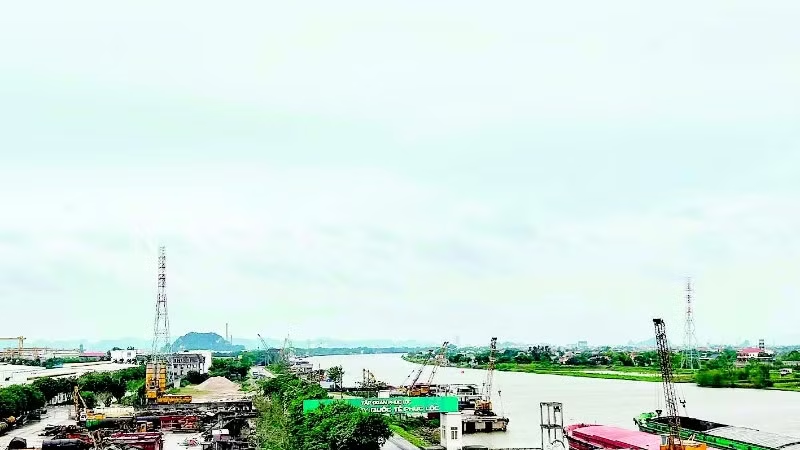
(HSV VIETNAM GROUP) – Inland waterway transport has great potential with a dense river system connecting industrial parks and large seaports across the country. This is a method of transporting large volumes of goods, with lower costs than other types of transport and is environmentally friendly.
Vietnam currently owns a dense river system with a total length of approximately 41,900km, of which 17,253km (accounting for 41.2%) is being managed and exploited as inland waterways.
Increase transport capacity
Inland waterway transport has the advantage of low costs and the ability to transport large quantities of goods, especially raw materials, agricultural products and industrial goods; contributing to promoting inter-regional connectivity, closely connecting localities, connecting industrial parks and processing centers with large international seaports such as Hai Phong and Quang Ninh ports, creating favorable conditions for export and import.
According to the Ministry of Construction, maritime and inland waterway transport always has a growth rate of about 10%-12%/year. Inland waterway transport volume accounts for about 1/5, approximately 20% of the total volume of goods transported by all types of transport. According to statistics from the Vietnam Maritime and Waterways Department, the whole country has about 235,000 inland waterway vehicles with a total tonnage of more than 19.6 million tons. The size of vehicles has clear differences between regions. The north has an average load capacity of about 350 tons/vehicle, 4 times higher than the national average, while the south has more than 199,000 vehicles (88%), mainly small vehicles serving short-distance transport.
Mr. Tran Dinh Trong, Director of Hoang Trong Waterway Transport Company headquartered in Hai Phong, said that in recent times, many transport enterprises have invested tens of billions of VND in building 180 Teus river-sea ships to run along the coast of Hai Phong area, going deep into river ports such as from Dinh Vu to Lach Huyen, continuing to Lach Giang Ninh Binh estuary, through Nghia Hung canal to Day river and back to Ninh Phuc waterport.
Currently, river transport in the Red River Delta is being focused on upgrading and modernizing until 2030, with a vision to 2045, in order to convert from road to waterway, reducing logistics costs. The focus is on developing infrastructure, main transport corridors, seaport connections, creating motivation for regional economic development according to Resolution 30-NQ/TW. The Vietnam Maritime and Waterways Administration has just submitted to the Ministry of Construction a master plan to develop infrastructure and inland waterway transport services for the period 2026-2035. Oriented to 2050, inland waterways will become the backbone transport mode in transporting large volumes of goods and inland-coastal transshipment, accounting for over 35% of the total national transport output.
Developing "green" transportation
According to industry experts, the development and implementation of the overall project to develop infrastructure and inland waterway transport services plays a very important role, and is an important tool to synchronously deploy major policies, specifically contributing to the realization of the double-digit GDP growth target through reducing logistics costs and improving national competitiveness. However, it is necessary to study the entire national inland waterway network from its infrastructure system, means of transport, related services and management policy mechanisms. In particular, we focus on main transport corridors, especially the Red River Delta and Mekong Delta regions.
The results of the research will contribute to the direction of synchronous and modern development of infrastructure and means of transport, increasing the proportion of inland waterway transport, reducing logistics costs; Developing logistics associated with water transport, increasing multimodal connections and regional links.
According to the Ministry of Construction, in the coming time, in addition to developing the inland waterway transportation network, the transportation industry needs to continue to promote the application of science, technology and digital transformation, through the application of digitalization in route management, modernizing ports, exploiting big data and enhancing logistics connections. Along with that, it is necessary to promote the role of the private economy through promoting socialization of investment in ports and fleets. In particular, the development of infrastructure and inland waterway transport also meets global trends and Vietnam's commitment at COP26 to achieve net zero emissions by 2050. With low CO2 emissions, inland waterways are a "green" and sustainable mode of transport, playing a central role in the green transformation of the transport industry.
Ha Diem HSV