
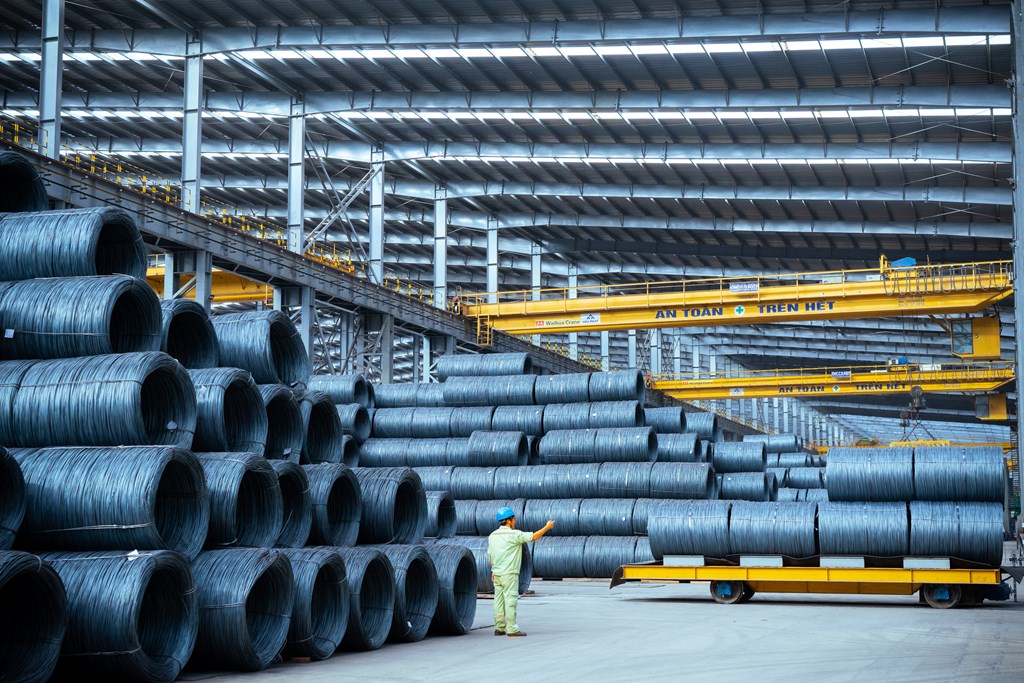
(Hanoi Iron and Steel – HSV) According to forecasts, the difficult situation and losses of steel enterprises will last until the end of the fourth quarter and may continue in early 2023.
According to a report from the Vietnam Steel Association (VSA), steel production and demand throughout 2022 are not assessed to be really good, many businesses face difficulties due to rising costs, sharp fluctuations in steel prices and large inventories.
Consumption decreased
VSA said that in the first 11 months of 2022, the global economy will face difficulties when inflation increases and manufacturing industries grow slowly; including industries that use steel. Prices of raw materials for steel production fluctuate strongly. Specifically, the prices of iron ore, scrap steel, and coke from the beginning of the second quarter and third quarter of 2022 have continuously decreased, with a decrease of 50-60% compared to the first quarter of 2022. Steel manufacturing enterprises are greatly affected, production and business activities are difficult and ineffective. In the world, a number of large steel corporations plan to close blast furnaces and in Vietnam, large steel factories have also had to stop blast furnace operations such as Hoa Phat, Formosa, Tisco... or postpone production plans such as Southern Steel, Maruichi Sunsco...
Construction steel production in November continued to decline compared to previous months and the same period in 2021 due to some steel companies cutting production. Specifically, construction steel production in November reached 682,000 tons, down 5.28% compared to the previous month and down 37.2% compared to November 2021.
Steel consumption plummeted by 22.73% and reached just over 874,000 tons, on par with the same period in 2021; Of which, construction steel exports reached more than 97,000 tons, down more than 52% compared to November 2021.
The decline in the consumer market when the real estate market slowed down, foreign exchange rate fluctuations... put many factories in difficult situations due to high inventory prices. Factories whose business results have declined due to competition in selling prices and market share have now temporarily suspended selling price reductions. Trading companies and distributors limited purchases and transactions became worse, mainly aiming to collect debts due to the close to the end of the year.
Domestically, the pressure of weak and slow demand in the domestic market has caused construction steel prices to continue to adjust downward. Besides, the downward movement of input material prices is also one of the factors for manufacturers to adjust construction steel prices. Demand recovery is hindered by pressure from rising interest rates. Banks have tightened credit, the real estate market has had prolonged difficulties, and customers have been cautious in the face of forecasts of a global economic recession. This is considered the main reason why construction steel prices have been continuously adjusted downward in recent times, VSA said.
Facing the above difficulties, according to Hoa Phat Group's report, this group in November only produced 384,000 tons of crude steel, down 43% over the same period last year; Consumption of steel products reached 443,000 tons, down 30%; Of which, construction steel increased by 20% compared to October but still decreased by 7% over the same period in 2021, while hot rolled steel coil (HRC) decreased more sharply, about 12%.
Overall, in November 2022, production of finished steel products of all types reached more than 1.8 million tons, down 10.78% compared to October and down nearly 37% over the same period in 2021; Steel consumption reached more than 1.9 million tons, down 16.2% over the same period. Cumulatively in the past 11 months, finished steel production reached more than 27 million tons, down 11.3% over the same period; Consumption reached more than 25 million tons, down 6.8%; Of which exports reached more than 5.7 million tons, down 19.3% over the same period.
Does the bright spot come from public investment?
According to the 2023 plan, the Government's policy is to focus on promoting public investment to restore and develop the economy. The Government's very high determination clearly shows that capital is always available, and at the same time, it always strongly urges ministries, branches and localities to implement planned targets for disbursement of public investment capital. According to Mr. Nguyen Van Sua, a steel industry expert, this is considered a "leverage" for steel businesses, helping to create a "bright spot" to partly compensate for the weakness of the residential real estate sector.
It is expected that there will be 793,000 billion VND for public investment disbursement in 2023, an increase of 34% compared to the 2022 public investment plan. Mr. Sua said that to help the steel market recover, the Government and localities, ministries and branches need to accelerate public investment disbursement as well as deploy support for domestic steel enterprises to maintain market share and have motivation to develop. In the past year, we only disbursed more than 58.3% of the capital, so there are still many hindering problems.
Comments from the World Steel Association (WSA) show that world steel demand will increase again by about 1% in 2023 thanks to the motivation of public investment as well as the controlled energy shortage situation in the world; In which, the ASEAN region will lead the growth in steel consumption thanks to strong investment orientation in infrastructure. This is expected to continue to be the main export market for Vietnamese steel in the coming time.
In addition, steel supply in the European market in 2023 is forecast to continue to be in short supply due to high energy prices. Vietnamese businesses can boost exports to this market.
According to VSA's forecast, the difficult situation and losses of steel enterprises will last until the end of the fourth quarter and will likely continue in early 2023 due to unsatisfactory export activities and fierce competition among manufacturers; Tightening monetary policies, increasing interest rates, and escalating exchange rates can negatively affect demand and production and business activities of units in the steel industry. But with strong solutions in disbursement of public investment capital for construction and transportation projects... the steel market still sees "bright spots" in 2023.
As information from Hoa Phat said, although domestic construction steel consumption recovered slightly compared to last month, the export market decreased by more than 70% over the same period. In addition, the consumption of downstream steel products also faces difficulties due to a quiet market. In the cumulative 11 months, Hoa Phat Group has produced 7 million tons of crude steel, down 6% compared to the first 11 months of 2021. Consumption of construction steel, steel billets, and HRC reached more than 6.6 million tons, down 6%, mainly due to there being no steel billet export orders like last year.
To alleviate difficulties, this group is focusing on strict inventory management to reduce the burden on working capital needs and short-term debt. For exports, when demand in the US, Europe and China is weak, Hoa Phat focuses on exploiting other markets less affected by inflation and economic recession such as Southeast Asia and some other countries in Asia.../.