Hanoi Iron and Steel (HSV) - China's steel industry is facing a double shock from the slow economic growth and the real estate market crisis. This causes the profits of businesses to spiral downward sharply.
Double shock to the Chinese steel industry
For China's steel industry, this year's winter came earlier and was harsher in the face of a double shock, including slow economic growth and an escalating real estate crisis that caused demand and profits in the steel industry to evaporate, according to Nikkei Asia.
Specifically since the end of 2021, China's tightening of the real estate market - a field that accounts for more than a third of the country's steel consumption - has caused liquidity and sales to decline sharply, with many home buyers refusing to pay mortgage loans due to dissatisfaction with stalled construction projects.
According to data from the China Bureau of Statistics, in the first 7 months of the year, home sales decreased by 23.1% over the same period last year, while investment in real estate development also decreased by 6.4%.
Mr. Wu Xiuqing, Senior Executive Director of steel company Hebei Xinda Iron and Steel said: "There is no way to help the steel industry recover when the real estate market is weak. In the first half of this year, rebar output - mainly used for housing construction - decreased by 13.8% compared to the same period last year."
This person forecasts that steel consumption in the real estate industry will decrease by 5% this year, to 50 million tons. Even if demand from the fields of infrastructure investment and automobile production increases, it will be difficult to compensate for this decline.
Along with that, the complicated developments of the COVID-19 epidemic have disrupted business activities and disturbed China's domestic supply chain. In addition, world demand for steel also weakened due to Russia-Ukraine tensions, causing slow economic recovery. Experts say that China's steel market is facing a "perfect storm".
According to Mysteel data on July 22, more than 80% of China's 500 steel factories are operating at a loss, while the average profit margin of 247 companies surveyed has dropped to 9.96%, possibly even to a record low of 4.29% in December 2015 due to oversupply.
Even Baowu Group, China's largest steel manufacturer, also issued a warning about the challenges the steel industry will face, which is that sales, prices, and profits will all plummet.
“It's time for the steel industry to prepare for a long winter,” said Chen Derong, Chairman of Baowu.
Baowu's report also points out that the steel market may decline more strongly than in 2015 and shows no signs of ending.
In addition to the oversupply crisis, rising global inflation and geopolitical risks also pushed the Chinese steel industry into a deep hole.
According to the China Iron and Steel Association (CISA), China's current steel production capacity is about 1.2 billion tons/year while consumption is at 1 billion tons and 95% of steel output is consumed domestically.
Mr. He Wenbo, Executive Chairman of CISA, said the imbalance in supply and demand in China's steel industry is a long-standing problem. China's steel industry has expanded rapidly for more than two decades as the economy achieved double-digit growth.
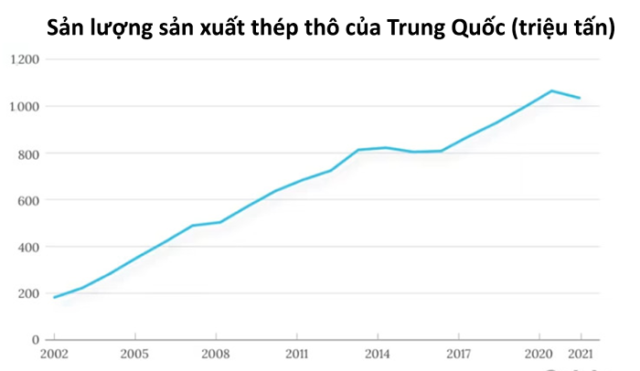
The country has remained the world's largest steel producer since 1996 with a record 1.07 billion tons in 2020. At the same time, China is also the world's No. 1 steel consumer, accounting for more than 50% of total global production.
However, Mr. He Wenbo said that the glorious period of China's steel industry is over, steel demand is trending down and forcing the industry to adjust.
Corporate profits spiral downward
The double shock has caused the profits of steel industry enterprises to spiral downward since mid-March.
According to Mysteel statistics, steel industry profits have dropped sharply. In March, 80% of businesses still reported profits, but by July only 20% remained. This number recovered somewhat to more than 50% by mid-August. Additionally, only 5 out of 25 domestic listed steel companies estimated profits increased in the first half of the year.
This situation is similar to ferrous metal (raw steel) smelting and rolling plants. Accordingly, factories' profits fell 94%, from 23.7 billion yuan in April to 2.4 billion yuan in June. Meanwhile, steel inventories increased 50% from the beginning of the year to 16.95 million tons at the end of June.
Steel manufacturers say they are stuck between rising raw material costs and falling selling prices. Specifically in the first half of the year, iron ore import prices fluctuated at a high level of 100-109 USD/ton, while coking coal and coking coal prices increased by 68% and 28% respectively over the same period in 2021.
Meanwhile, the price of rebar on the Shanghai futures exchange decreased from 5,190 yuan/ton in early April to 3,683 yuan/ton on September 2.
Enterprises in the industry are worried that in the second half of 2022, the Chinese steel market will be even more unstable due to domestic COVID control policies and the global recession.
In the July world economic outlook bulletin, the IMF forecast that the global economy will grow slowly, from 6.1% last year to 3.2% in 2022, 0.4% lower than the April forecast.
Last August, investment bank Goldman Sachs also lowered China's 2022 GDP forecast from 3.3% to 3%, while Nomura Group reduced its outlook from 3.3% to 2.8%.
"The most important thing right now is to survive. We cannot blindly bet our lives on recovery because the chances are too low," said a steel trader.
Private steel manufacturers, who were rushing to expand capacity when the steel industry boomed, are now under great pressure.
"We need to prepare for a loss scenario in the next five years," said Li Ganbo, chairman of steel enterprise Hebei Jingye Group.
Increase competition in the iron ore market
To prepare for the difficult times ahead, many businesses have proposed that the government accelerate the process of reforming the steel industry, eliminating outdated capacity, upgrading technology and environmental standards.
In addition, the authorities have had a number of solutions to control domestic raw materials with the expectation of improving competitiveness in the international iron ore market. Among them, the important move mentioned at the end of July was the establishment of a state-owned iron ore corporation to increase investments in mining and coordinate the import of steel production materials for factories.
The establishment of the 20 billion yuan ($3 billion) China Mineral Resources Group is part of China's long-standing pursuit to enhance its position in the iron ore market, which is already dominated by four giants, including Rio Tinto Group, BHP Group, Fortescue Metals Group and Vale.
Currently, leaders of the China Mineral Resources enterprise are busy visiting state-owned and private steel mills, commodity exchanges and shippers to strengthen business relationships.