
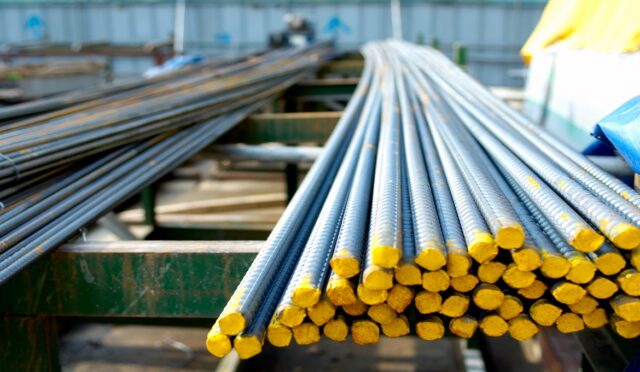
(Hanoi Iron and Steel - HSV) Facing a series of macroeconomic pressures weighing on economic growth prospects, the iron and steel industry in the world continues to face many challenges, especially in terms of consumption capacity. For the iron and steel market in Vietnam, difficulties will be unavoidable, but opportunities are still open for domestic manufacturing enterprises in the fourth quarter of this year.
Reduce pressure from input material prices for the steel production industry
During the first half of the year, the market witnessed a sharp increase in prices of raw materials serving the steel production industry due to a series of supply risks. This has pushed world steel prices in general and domestic steel prices in particular to continuously increase. However, at the present time, production costs have cooled significantly, helping steel enterprises' profit margins improve compared to the previous period.
According to the Vietnam Commodity Exchange (MXV), the MXV-Index Metal index ended the trading day September 28 at 1,528 points, nearly 20% lower than at the beginning of the year. One of the reasons for this decline is the weakness of many basic metal products, especially the price of iron ore traded with the Singapore Exchange (SGX). Compared to the peak set in early March at 165 USD/ton, SGX iron ore price has lost 40% of its value, currently reaching 94 USD/ton.
In addition to iron ore, prices of other important input materials also show a significant downward trend. The price of coking coal fell from 640 USD/ton in mid-March to less than 300 USD/ton and lower than the price at the beginning of the year. Scrap steel prices also decreased by about 30% compared to the peak this year. Other inputs, especially the cooling of gasoline prices, have contributed to reducing cost pressure on manufacturing enterprises.
However, it must be recognized that the downward trend partly stems from the fact that iron and steel consumption in the world is still quite weak. That will pose significant challenges for global iron and steel manufacturers in general and in Vietnam in particular.
The steel industry's big challenge will depend on the demand problem
Mr. Pham Quang Anh, Director of the News Center at MXV, said: "If in the first half of this year, supply factors strongly influenced the prices of input materials as well as finished iron and steel products, at the present time, the problem of demand is the most dominant factor. In the context of a series of countries, especially the US and countries in the European region (EU), continuously increasing interest rates to control hyperinflation, the risk of increased recession will cast a shadow on development. world consumption of iron and steel.”
In the US, interest rates are at 3.0 - 3.25% after 5 consecutive increases from March until now. This is also the highest level since 2008 and this has contributed to pushing up real estate mortgage interest rates. According to data from the American Real Estate Association, the average interest rate for a 30-year mortgage is at 6.5% and is the highest level since the great financial crisis of 2008. The index measuring home affordability for first-time buyers dropped to the lowest level since 2007, reaching 68 points, much lower than the threshold of 96.1 earlier this year. It should be noted that the structure of steel usage in the global construction and real estate sectors accounts for about 52% of total consumption by sector.
Meanwhile, in the world's leading iron and steel consuming country, China, demand recovers relatively slowly under pressure from the stagnant real estate sector and the epidemic is still complicated.
Facing barriers to global consumption prospects, Vietnam's iron and steel exports this year have continuously encountered difficulties. As of mid-September 2022, our country has exported more than 6.1 million tons of iron and steel, down more than 30% compared to the same period last year. In August of this year alone, the amount of iron and steel exports decreased by about 66% compared to the same period in 2021.
Meanwhile, imports maintained stability as the period from the beginning of the year to September 15 only decreased slightly by 8.5% compared to the previous year. This shows that the domestic steel industry is gradually trying to reduce its dependence on the world, but the problem of global consumption is really a difficult problem for export activities that bring high economic value.
Vietnam's steel industry can still take advantage of opportunities from challenges
Although difficulties are still unavoidable, the fourth quarter will contain more opportunities for steel manufacturing enterprises in Vietnam.
Regarding international trade activities, according to MXV, in the context that the steel industry in the EU region is facing a series of risks from the energy crisis, causing many factories to cut production and face closure, Vietnam can take advantage of the opportunity to promote exports to this potential market.
Recently, the Aperam steel plant in eastern Belgium had to make the decision to stop production due to being unable to cover fuel costs, especially when gas flows were disrupted due to geopolitical instability. Arcelor Mittal, the world's second largest steel manufacturer, is also scaling back production to limit losses. If this situation lasts, the steel production industry in the EU may be paralyzed and largely dependent on imports from other countries.
Currently, this region accounts for 18% of our country's steel exports, just behind the ASEAN region. In the first 8 months of this year, Vietnam's iron and steel exports to most major markets decreased compared to the same period last year, however, the export volume to the EU increased slightly by 0.8% and this number will likely continue to increase in the fourth quarter.
In addition, the competitiveness of Vietnamese steel, especially construction steel, is also more open in the context of China restricting steel exports to aim at reducing carbon emissions. The end of the year will also be the construction season for this country, so the consumption picture promises to improve.
For domestic consumption, the fourth quarter will also be a golden time for a breakthrough in progress of a series of construction investment projects. The remaining capital planned to be disbursed in 2022 and 2023 will be a strong driving force to promote infrastructure development and be a positive signal for the iron and steel industry in Vietnam.