(HSV VIETNAM GROUP) - In the context that most key export industries such as textiles, garments, seafood, wood... have declined sharply, agricultural and fruit exports have become a bright spot for the economy. More importantly, after the Covid-19 pandemic and the current drought, agriculture continues to affirm its position as a pillar of support for the economy.
Vegetables and fruits shine brightly, many products break records
If in 2022, the seafood industry makes a breakthrough with an almost vertical growth chart, then by 2023, rice and vegetables will become representatives of Vietnamese agricultural products creating a reputation in the international market.
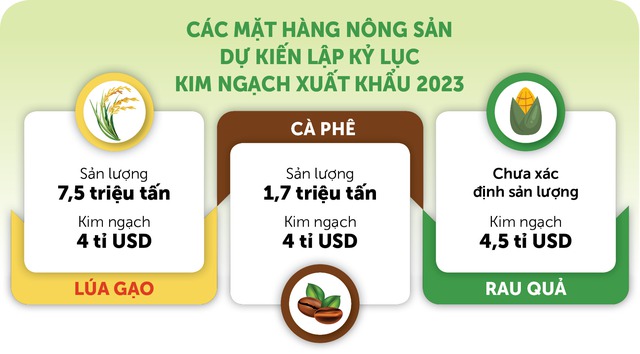
The fruit and vegetable industry is making rapid progress to set a new record in export turnover. According to estimates by the Ministry of Agriculture and Rural Development, by the end of 2023, the two products of vegetables and rice will reach the highest turnover ever, over 4 billion USD. In particular, for the first time, durian rose to the top position among fruit crops with export turnover reaching 2 billion USD. Speaking of the sudden growth of durian, it is impossible not to recall the signing of the Official Export Protocol to China from the second quarter of 2022. Since then durian fruit has brought "huge" income to growers and contributed to the overall growth of the fruit and vegetable export industry.
Not only exporting fresh fruits and not only depending on the Chinese market, domestic enterprises are also expanding the durian export market to 24 countries and territories. "Durian fruit still has a lot of room for growth. In addition to the Chinese market, which accounts for 90% of exported durian output, other markets also have potential for exploitation, especially frozen durian products and especially targeting the Indian market where the world's largest population is located," said Ms. Nguyen Thi Thu Huong, Deputy Director of the Plant Protection Department (Ministry of Agriculture and Rural Development).
Besides, the fruit and vegetable industry still has many other potential "stars" that promise to shine in the near future, including coconut. Recently, this item has been given the signal to open by the two largest consumer markets, the US and China. Mr. Cao Ba Dang Khoa, Acting General Secretary of the Vietnam Coconut Association, informed: "Vietnam's export turnover of deeply processed coconut products and raw products such as coconut milk powder, desiccated coconut... has continuously increased in recent years, reaching the fourth position in Asia.
Statistics show that the export value of coconut and coconut products in 2022 will reach over 900 million USD. Currently, due to the impact of the general situation, coconut export value has decreased by about 32% compared to the same period in 2022, reaching about 215 million USD. However, in the long term, the export potential of the coconut industry is still very large. With the preparations to open the Chinese market and the reopening of the US market, Vietnamese coconuts will soon reach a turnover of 1 billion USD.
Besides, domestic coffee production is also strongly reviving. Coffee prices, after many years of being below 40,000 VND/kg, have suddenly skyrocketed since the beginning of 2023, and have now nearly reached the threshold of 70,000 VND/kg. "For many years, the price of Vietnamese coffee has not exceeded 50,000 VND/kg, so the current price is almost a dream for businesses and farmers. When the new coffee crop begins in October - November every year, the price may decrease a bit but is likely to still remain high," said a representative of a coffee export business in Dak Lak. The Ministry of Agriculture and Rural Development also forecasts that coffee products could break the previous year's export turnover record and 2023 will be the second consecutive year that Vietnam will reach a turnover of over 4 billion USD in coffee exports.
Rearrange the "industry position", optimize national advantages
In the difficult domestic and global economic context, agriculture has emerged as a pillar of support for the economy. Looking back at the agricultural export journey last year, Mr. Nguyen Quoc Toan, Director of the Center for Digital Transformation and Agricultural Statistics (Ministry of Agriculture and Rural Development), commented: "It can be said that the agricultural sector is proud of its achievements. Climate change, epidemics and crises have negatively impacted global economic activities. However, Vietnam's agricultural product exports have emerged as a bright spot of the entire country's economy. Success in agricultural product exports must be counted. leading to a huge shift in production, followed by the expansion of exploiting new markets and especially taking advantage of new generation trade agreements."
On the other hand, according to Mr. Nguyen Quoc Toan, when some industries such as rice and durian grow rapidly, it also reveals all the weaknesses of the current agricultural industry, which is the lack of connection. Specifically, the current bottlenecks are quality management, inadequate processing infrastructure, poor links between gardeners, farmers, traders and businesses, leading to competition in purchasing and broken contracts...
Dr. Dang Kim Son, former Director of the Institute of Policy and Strategy for Agricultural and Rural Development (Ministry of Agriculture and Rural Development), also wondered: "In Vietnam, although the State, businesses and people have spent a lot of effort to link four houses, build large sample fields, build value chains... but in the production of commodities in general and rice in particular, the stages are still separate. Production is left to farmers, purchasing from farmers is left to traders and traders. Enterprises have processing factories. Many export enterprises only sign contracts to sell rice and mobilize from milling factories in a "ship-to-ship" manner.
The situation of export contracts with outside parties being signed first, and then buying rice according to domestic prices, so when price fluctuations occur, conflicts arise and the relationship instead of collaboration turns into confrontation. If the current weak organization is maintained, it will create opportunities for transnational FDI corporations to move in and dominate strategic agricultural industries in which Vietnam has advantages. At that time, domestic businesses and especially farmers only enjoyed a small profit as contributors of labor along with all risks of epidemics, natural disasters and environmental pollution... In fact, Vietnam has been accepting this situation in many industries and agriculture, which is currently being pushed back in animal husbandry, encroaching on fisheries, coffee...".
According to Dr. Dang Kim Son, to gain a foothold at home and promote the national advantage of the agricultural industry, local and industry leaders need to rearrange the position of each industry and establish the position of agricultural workers in general and rice farmers in particular. It is absolutely necessary to determine where the rice is, where the fruit trees are, and where the seafood is in a specialized farming area like the Mekong Delta. The Central Highlands must clearly understand where the coffee is, where the pepper is, where the fruit trees are, where the forests are... Only then can we invest synchronously in infrastructure, logistics, processing plants, and human resources. In specialized farming areas, it is necessary to identify and support large businesses to lead small businesses, cooperatives and farmers.
Once there are horizontal links between farmers, businesses and localities, vertical links will be built and organized. That vertical link solves the problems of how to build a specialized farming area, how to organize production, how to find markets, how to price, how to process, how to cooperate internationally... Together forming a specialized farming area is a vertical link, the value chain is a vertical link, and the highest is the industry council.
Being able to connect with farmers is a win
Mr. Le Duc Thinh, Director of the Department of Economic Cooperation and Rural Development (Ministry of Agriculture and Rural Development), analyzed: The weakest point of the agricultural sector today is the lack of connection. Whether slow or fast, modern agriculture cannot be self-competitive but must be organized according to supply chains and value chains.
"Of course we're going slowly, but if we don't start today, it will be very difficult for us to do it in the near future. Previously, we had a decree to link up and in the link there were also sanctions and that, but that decree still had some limitations, especially in the story of organizing and implementing... In the chain of links, the trap we always encounter is that it is heavy on price. The problem is that the price factor is very difficult to manage, even for businesses. How do farmers and cooperatives come together? There is nothing more than everything that must support the welfare and benefits of farmers. We need to focus on helping farmers produce high-quality agricultural products, we help farmers reduce product costs, we help farmers have enough knowledge about the market to have enough coping skills, help farmers access credit...", Mr. Thinh emphasized and said that the current connection between buyers and sellers only stops at signing sales contracts but this is not enough.
If we talk about competition, Vietnamese businesses lose to multinational businesses in everything, lose in potential, lose in market, but we have an advantage: if we can link with farmers, we win. So whether it's slow or fast, we have to do it and work persistently so that the production-consumption connection becomes more and more extensive. Only then can we overcome the current weaknesses of Vietnam's agricultural sector and bring the position of Vietnamese agricultural products higher and higher.
Chairman of the Vietnam Confederation of Commerce and Industry (VCCI) Pham Tan Cong said that in the current context, to realize the goal of the agricultural sector in the coming period of "Developing smart agriculture, international integration, adaptation to climate change, increasing added value and sustainable development; prosperous and civilized new rural areas, rich farmers" requires more participation and demonstration of the role of businesses. It is businesses who will pave the way for Vietnam's agricultural sector to gradually advance, affirm its position in the world and from here, bring production efficiency and increase income for farmers.
"Recently, the Government has issued many policies to attract businesses to invest in agriculture. The above policies show that the State is very interested in encouraging businesses to invest in agricultural and rural development. However, investing in agriculture always contains many unpredictable risks, so to put the policy into practice, the Government and localities need to pay special attention to removing difficulties and creating favorable conditions for agricultural businesses, and need to build successful models and businesses in this field. Invest in agriculture to replicate and encourage, creating confidence for potential investors," Mr. Cong emphasized.
Ha Diem HSV