
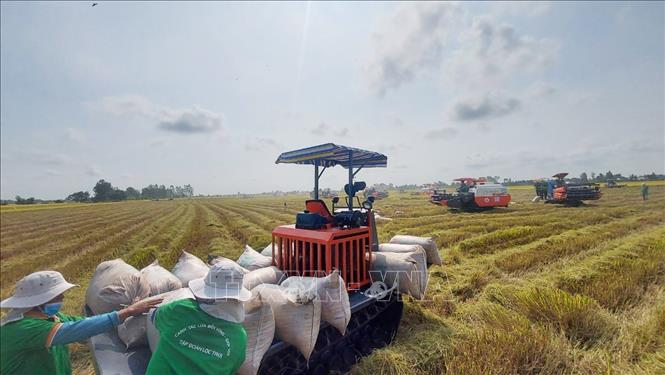
(HSV VIETNAM GROUP) – Agriculture is experiencing a strong acceleration in exports right from the beginning of the year with an increase in the first quarter of 2024 of nearly 22% compared to the same period last year. Deputy Minister of Agriculture and Rural Development Phung Duc Tien emphasized: If units promote trade promotion, the industry will have a favorable year of exporting agricultural, forestry and fishery products, achieving the target the Prime Minister assigned to the industry of 54-55 billion USD.
The agricultural sector has 4 products with an export value of over 1 billion USD and all of them are growing quite strongly. That is wood reached 2.32 billion USD, an increase of 26.8%; fruits and vegetables 1.23 billion USD, up 25.8%; rice 1.37 billion USD, up 40%; coffee 1.9 billion USD, an increase of 54.2%.
In particular, rice, vegetables, coffee... have continued strong growth from 2023.
In the first quarter, Vietnam exported 2.07 million tons of rice, an increase of 12% in volume but an increase in value of 40% and reaching 1.37 billion USD. Rice export prices in the first months of the year decreased compared to the end of 2023, but still increased by 25% over the same period in the first quarter of 2023; The average export price in the first quarter of 2024 reached 661 USD/ton.
The Ministry of Agriculture and Rural Development forecasts that 2024 will continue to be a year of many opportunities in rice export and reach over 8 million tons.
According to the Vietnam Food Association (VFA), the market share of fragrant rice of all kinds continues to increase sharply compared to previous years due to increased output, competitive prices and especially the ability to meet the diverse consumption needs of markets, typically: OM5451, Jasmine, fragrant broken rice...
Rice exports are forecast to continue to be vibrant as demand from major consuming markets in Southeast Asia such as Indonesia, the Philippines, Malaysia, China and Africa increases due to concerns that El Nino hot weather will last until mid-2024. Domestic rice prices are also forecast to continue to stabilize at a high level.
The Association will strengthen trade promotion, support the dissemination of import-export policies to the Vietnamese rice export business community and continue the transition period to adapt to the need for innovation and restructuring towards enhancing value and sustainable development, said Mr. Nguyen Ngoc Nam, Chairman of the Vietnam Food Association.
This year, vegetable exports are expected to continue to surpass the historic milestone in 2023. In the immediate future, in the first quarter, fruit and vegetable exports have reached 1.23 billion USD, an increase of 25.8%. This is the first time fruits and vegetables have exceeded 1 billion USD in the first quarter of the year.
Recently, the Plant Protection Department requested localities and local specialized agencies to review and synthesize growing areas and packaging facilities for fresh coconuts and frozen durians exported to China. This is to speed up the process of opening the market for fresh coconuts and frozen durians exported from Vietnam to China and prepare all conditions for registration of planting area codes and packaging facilities after the Protocol is signed.
"If Vietnamese frozen durian and fresh coconut are opened to China soon, fruit and vegetable exports will continue to have a strong breakthrough," shared Mr. Dang Phuc Nguyen, General Secretary of the Vietnam Fruit and Vegetable Association.
However, recently Vietnam had 30 durian shipments warned by China due to being contaminated with heavy metal cadmium exceeding the food safety regulation limit of this market. This is data compiled since Vietnam was allowed to export durian to China. Although it has not affected exports, it also shows that this market not only cares about pests but also the quality of internal products.
The Plant Protection Department recommends that production units pay attention to the use of agricultural inputs and adjust farming methods to reduce cadmium absorption, such as using organic fertilizers and manure at reasonable rates.
In addition, before exporting, businesses should also proactively check product quality, including cadmium content, to avoid risks if China continues to detect and apply stronger measures. The Plant Protection Department continues to guide growing areas and packaging facilities to strictly comply with plant quarantine requirements. Local authorities and authorities promote inspection, examination and supervision of growing areas and packaging facilities to control the quality of exported agricultural products right from the input and cultivation stages; Detect and promptly handle cases of violations and fraud in export.
Photo captions
Packing processed shrimp products for export to Japan. Photo: Hong Dat/TTXVN
Regarding seafood, export turnover in the first quarter of 2024 reached 1.86 billion USD, a slight increase of 1.9% over the same period in 2024.
The Vietnam Association of Seafood Exporters and Producers said that the US, Japan and China are the Top 3 largest import markets of Vietnamese seafood; Of which, exports to the US had a much stronger breakthrough, with a growth rate of 16% reaching 330 million USD; Exports to Japan were equivalent to the same period, while exports to China increased by 15%.
The US Department of Commerce (DOC) recently announced the final results for the 19th anti-dumping tax review (POR19) on Vietnamese frozen pangasius fillets exported to the US in the period from August 1, 2021 to July 31, 2022. The final tax rate for POR 19 has been set at $0.18/kg for the five companies. This result is significantly lower than previous reviews. Recently, DOC announced preliminary anti-subsidy taxes on Vietnamese, Indian and Ecuadorian shrimp, according to which Vietnam's overall tax rate is significantly lower than the other two countries.
Experts say that the seafood export market has not completely recovered, there are still challenges, barriers and competitive pressures with other countries, the EU market's IUU yellow card issue, anti-subsidy taxes in the US, Red Sea tensions and trade conflicts leading to more competition in the US and China...
Therefore, Vietnamese businesses need to be ready to face challenges and overcome barriers, but also need to proactively seek customers from international seafood fairs and exhibitions in the US, Europe, Japan, and Korea to be able to recover and break through sooner.
A field that has always had a low export turnover like livestock but is also making certain progress. In the first quarter of 2024, the export turnover of livestock products is estimated to reach 113 million USD, an increase of 4.8% over the same period in 2023. In the near future, livestock will have the first chicken product exported to the Halal market.
Meanwhile, livestock production has always developed stably thanks to good disease control. Deputy Minister of Agriculture and Rural Development Phung Duc Tien said that to create a big push and promote exports, the livestock industry needs to increase cooperation opportunities in the context of implementing regulations of the CPTPP and EVFTA Agreements; Survey and evaluate the market, seek export opportunities for Vietnamese livestock products to a number of countries in ASEAN, Asia, America, and the EU. In addition, solving existing problems, obstacles and difficulties of businesses and livestock farmers in the context of complex developments of epidemics (for humans and livestock) and great market pressure on livestock products.
Assessing the export market for agricultural, forestry and fishery products, Deputy Minister Phung Duc Tien said that China and the US are two large markets consuming Vietnamese agricultural products. In particular, China is Vietnam's largest agricultural product consumption market. This is also a market with low logistics costs. The two sides have signed many protocols to promote trade in agricultural products. The two sides are pushing to soon sign a protocol to export frozen durian, coconut, and shrimp. If signed, agricultural exports to this market will have outstanding growth.
Particularly for this market, Mr. Ngo Xuan Nam, Deputy Director of the National Notification and Inquiry Point Office on Sanitary Epidemiology and Plant and Plant Quarantine (SPS Vietnam), said that the office continues to actively coordinate with units to disseminate and guide businesses and localities to meet Regulation 248 and Regulation 249 of the General Department of Customs of China. Thereby, supporting and removing difficulties for businesses when bringing agricultural products to this market.
To date, GACC has approved 3,140 agricultural food product codes that Vietnamese businesses are allowed to import into the Chinese market, an increase of 180 codes compared to 2023 figures, Mr. Ngo Xuan Nam added.
According to Deputy Minister Phung Duc Tien, restructuring the industry must still respect the three product axes: national, regional and local. Through this, it helps create raw material areas associated with processing, promoting multi-value integration in agricultural, forestry and fishery products; shifting from the agricultural supply chain to developing commodity chains.
The agricultural sector must forecast the market, weather, epidemics... to promptly respond to all changes to truly accelerate and reach the finish line by 2025.
Ha Diem HSV