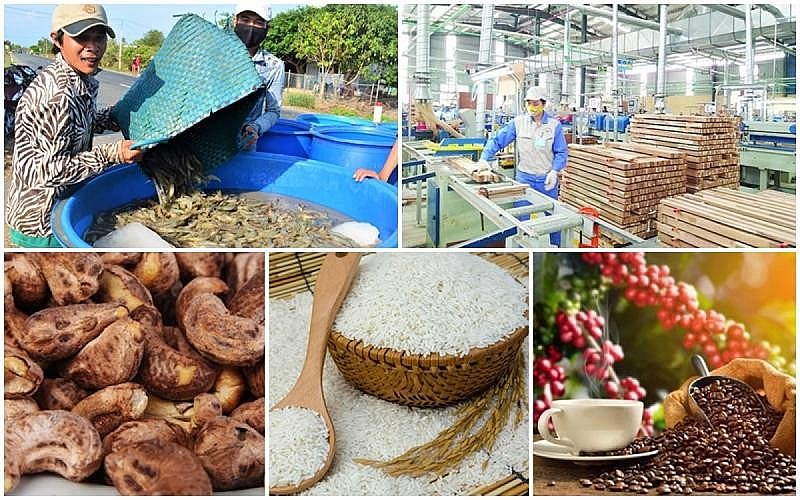
(HSV VIETNAM GROUP) – In 2024, China continues to be a potential market and there are many open opportunities for Vietnamese agricultural products to increase market share and export value.
More opportunities, increasing agricultural export turnover to China
China - the largest customer of Vietnamese agricultural products
According to a report from the Ministry of Agriculture and Rural Development, in 2023, China, the United States, Japan, EU, and ASEAN will continue to remain the 5 largest export markets of Vietnamese agricultural products.
However, last year, except for the Chinese market, which recorded positive growth, Vietnam's agricultural exports to key markets all had negative growth.
Specifically, agricultural export turnover to the Chinese market increases by 17% compared to 2022 and accounts for 23% of the total export value of our country's entire agricultural sector in 2023.
Accordingly, China officially surpassed the United States to become the largest customer of Vietnamese agricultural, forestry and fishery products. In 2023, China will spend up to 12.2 billion USD to import agricultural, forestry and fishery products from Vietnam.
By the end of 2023, Vietnam will have 3,013 business codes issued for exporting to China. Among them, 1,570 codes (accounting for 52%) are high-risk product groups managed by 5 competent agencies.
The remaining 1,443 codes (accounting for 48%) were registered by businesses themselves under Order 248. The groups of agricultural and food products that many businesses export to the Chinese market are mainly aquatic products and products of plant origin.
Mr. Ngo Xuan Nam - Deputy Director of SPS Vietnam Office - said that the Chinese market is one of the key markets for Vietnam's agricultural exports. China has recently issued regulations on food safety and animal and plant quarantine for each industry.
For Vietnam, there are industries that have traditionally exported to the Chinese market. However, there are currently industries that have signed agreements through protocols with the General Department of Customs of China to promote such as aquatic products, fresh fruit products, products of plant origin, and products of animal origin such as bird's nest to promote the export of agricultural products and foods.
Especially since 2021, China has issued Orders 248 and 249 on registration of agricultural and food export enterprises and management of import and export food safety. Recently, China has approved more than 3,000 product codes for Vietnam for agricultural and food processing factories exporting to China. Therefore, in recent times, promoting the export of agricultural products to the Chinese market has been relatively favorable.
Create conditions for spiny lobster to soon return to the Chinese market
According to experts, in 2024, China will continue to be a potential market and there are many open opportunities for Vietnamese agricultural products to increase market share and export value. Because according to the Ministry of Agriculture and Rural Development, the General Department of Customs of China has just agreed to complete and supplement a number of contents in the 3 Protocols on exporting wild aquatic products, exporting farmed crocodiles and exporting farmed monkeys from Vietnam.
In addition, China also agreed to open the market and speed up the completion of import procedures for Vietnam's key fruits, including avocado and passion fruit. This can be considered good news for farmers growing these agricultural products in the Central Highlands and Mekong Delta.
Regarding the livestock sector, the General Department of Customs of China also agreed to review documents for Vietnam to export poultry products to the Chinese market. This is the result of Vietnam's positivity and initiative after building many disease-free zones and exporting livestock products to previously difficult markets.
In addition, to strengthen cooperation between quarantine units in the border area, after the Lunar New Year of Giap Thin, the two sides will organize a briefing between functional forces along the border so that the units can increase exchanges, learn from experience and remove problems that arise during the implementation of tasks at the border gate.
Information about the working trip of the Ministry of Agriculture and Rural Development of Vietnam with the Ministry of Agriculture and Rural Development of China, the General Administration of Customs of China, and the Government of Guangdong Province, Mr. Tran Thanh Nam - Deputy Minister of Agriculture and Rural Development of Vietnam - said that with sturgeon, according to international law and the Protocols, this is a product that is allowed to be exchanged and traded as long as it is not on the restricted list of CITES. Vietnam pledges to create favorable conditions for businesses of the two countries to buy and sell products, including seeds.
Regarding spiny lobsters, your side has recently amended a number of regulations, especially prohibiting the exploitation of products in the wild, which falls under the category of wildlife conservation. However, the delegation of the Ministry of Agriculture has informed you that every year Vietnam has over 1,000 tons of spiny lobsters raised in cages. Each farming cycle takes about 13 - 18 months to harvest. Therefore, we ask you to pay attention and solve difficulties for seafaring fishermen.
Regarding this, China basically agrees and will create conditions for Vietnam's cotton lobster to return to the Chinese market. Along with the sturgeon issue, the two sides will add related content to the Protocol on veterinary hygiene and quarantine requirements for naturally exploited aquatic products, in order to boost the two countries' turnover.
Also according to Deputy Minister Tran Thanh Nam, 2023 will witness spectacular growth of durian, a product that has only been officially exported for more than a year. Currently, durian is a fruit with export value, reaching more than 2 billion USD/year. Therefore, we have the right to expect the products that will soon be opened by China.
With poultry, we have over 500 million birds, which have been successfully exported to Japan, Russia, and Korea. If it can further penetrate China's billion-people market, it will be the basis for the livestock industry to further promote the scale of farming and build biosafety zones.
However, the Chinese side also noted that we should pay more attention to product quality, design, and packaging, to avoid a situation where some poor quality shipments affect the entire industry value chain.
To stand firm and affirm the brand in the Chinese market, Mr. Tran Thanh Nam said, the product must meet all three factors: quality, design and reasonable price. Your side has basically agreed on creating conditions for Vietnamese agricultural products to access the large wholesale market in Guangdong province, even setting aside a space for display.
"Hopefully, through the above results, localities will focus on directing the construction of quality and safe agricultural and food supplies that meet the standards required by your side. Along with that, businesses will coordinate to build logistics chains to circulate goods regularly and quickly, reducing costs before reaching consumers," Mr. Tran Thanh Nam emphasized.
Ha Diem HSV