(HSV VIETNAM GROUP) – In 2023, China will still be Vietnam's largest fruit and vegetable export market, accounting for 65% of the market share.
The opportunity to export vegetables and fruits to the market of 1.4 billion people is increasingly open when at the end of 2023, Vietnam signed an additional protocol to export watermelons to this market.
It is expected that in 2024, China will open more doors for Vietnam's key fruits such as avocado, passion fruit, coconut... From these positive signals, this year fruit and vegetable exports to China will continue to "boom".
Many positive signals
Talking to Tuoi Tre, Mr. Huynh Tan Dat, Director of the Plant Protection Department (Ministry of Agriculture and Rural Development), said that signing the protocol on watermelon export is an important step in promoting the official export of Vietnam's traditional agricultural products and standardizing regulations on agricultural export between the two countries.
Up to now, Vietnam has 162 watermelon growing areas and more than 1,000 packaging facilities in 38 provinces that have been granted codes to export watermelons to China.
Mr. Dang Phuc Nguyen, general secretary of the Vietnam Fruit and Vegetable Association, said that the average annual export turnover of Vietnamese watermelons to China is about 50 million USD.
"Signing the official watermelon export protocol to China will help this product be expected to earn an additional 20-30 million USD per year. The most important thing is that goods inspection at the border gate will be much faster.
Chinese Customs will reduce the frequency of sampling and inspection to only 2-3%, so there will be no more worries about congestion when entering the peak season like the Tet holiday every year," Mr. Nguyen said. Meanwhile, Deputy Minister of Agriculture and Rural Development Tran Thanh Nam said that during the ministry's working trip to China in mid-January 2024, the General Department of Customs of China also agreed to open more key Vietnamese fruits, especially to speed up the progress of completing procedures to opening the door for Vietnamese avocados and passion fruits to enter the Chinese market.
"This is good news for avocado and passion fruit farmers in the Central Highlands and Mekong Delta," Mr. Nam commented.
Mr. Nam also said that during the recent working trip to China, the ministry's working group surveyed and worked with the Guangdong wholesale market and Shenzhen central agricultural market. "Your side agrees to bring Vietnamese agricultural products and fruits into these two wholesale markets.
Especially at the central agricultural market in Shenzhen, the market director agreed to set aside a large booth for Vietnamese OCOP products to be displayed and sold here.
This market accounts for 10% of goods traffic into the Chinese market and serves 40 million people in Shenzhen and Hong Kong.
Your side really wants to strengthen cooperation, including rice, fruit and OCOP products in this center" - Mr. Nam said and said that after the Lunar New Year, the working group of Shenzhen Central Agricultural Market will go to Vietnam to coordinate with businesses to discuss carefully how to cooperate along the logistics chain to bring Vietnamese fruits, vegetables and agricultural products deeper into this market of 1.4 billion people.
Durian is still the "trump card"
The General Secretary of the Vietnam Fruit and Vegetable Association said that in January 2024, fruit and vegetable exports are estimated to reach nearly half a billion USD (about 480 million USD), doubling compared to January last year. With optimistic signals about the market in the first month of the year, Mr. Nguyen believes that this year's fruit and vegetable exports will reach a turnover of 6 - 6.5 billion USD.
According to Mr. Nguyen, in 2024 and the following years, exports to the Chinese market will continue to "boom" with complete basis because in addition to the protocol on watermelon, we are negotiating to prepare to sign protocols on passion fruit, avocado, frozen durian, grapefruit, coconut...
"In 2023, China will account for 65% of Vietnam's fruit and vegetable export market share, and it is forecast that in 2024 it will account for about 70% of the market share. There is a close geographical distance between Vietnam and China, and very potential fruit and vegetable growing areas, so exporting vegetables and fruits to China is very convenient, consumer tastes are relatively similar, creating conditions for the fruit and vegetable industry to develop stronger," Mr. Nguyen believes.
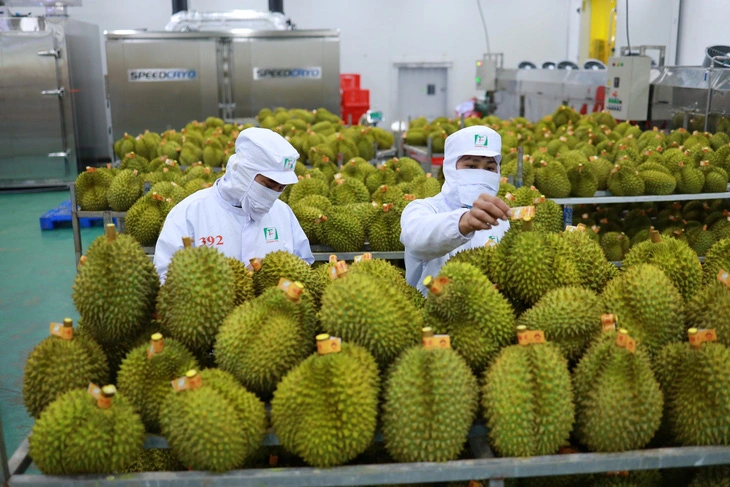
Mr. Nguyen also affirmed that in 2024 durian, coconut, banana, mango, and dragon fruit will still be Vietnam's strategic products, in which durian is still the "trump card" product because as of early January this year, there were 708 Vietnamese durian growing areas and 168 durian packing facilities allowed to export to China.
In particular, if the protocol on exporting frozen durian is signed early this year, fresh and frozen durian will bring in about 3.5 billion USD. Similarly, if the coconut protocol is signed, it promises to bring in 500 - 600 million USD.
"Due to the conflict in the Red Sea, exports by sea have to go around, lasting about half a month, so goods from Europe and America to China may be delayed and costs will increase. Therefore, China may lack vegetables and fruits during this Lunar New Year. This is an opportunity for Vietnam to take advantage of to increase the quantity and value of fruit and vegetable exports," Mr. Nguyen assessed.
Mr. Le Thanh Hoa, deputy director of the Department of Processing Quality and Market Development (Ministry of Agriculture and Rural Development), affirmed that China is still the key market for Vietnam's fresh fruit and vegetable exports. "In the future, if China opens its doors to coconuts, this will be a big boost for fruit and vegetable exports. It is also possible that coconuts will become a billion-dollar tree in the near future after dragon fruit and durian" - Mr. Hoa said.
Ha Diem HSV