(HSV VIETNAM GROUP) – With 8-month cashew export turnover reaching 2.28 billion USD, it is forecast that the cashew industry in 2023 will exceed the target of 3.1 billion USD set at the beginning of the year...
According to data from the General Department of Customs, in August 2023, Vietnam's cashew nut exports in August 2023 continued to record a new record high of 60.58 thousand tons, worth 333.83 million USD, an increase of 10.8% in volume and an increase of 9.7% in value compared to July 2023, an increase of 29.2% in volume and an increase compared to August 2022. 21.8% in value.
BREAKTHROUGH IN THE US MARKET
Accumulated in the first 8 months of 2023, Vietnam's cashew exports reached nearly 395.6 thousand tons, worth 2.28 billion USD, up 15.5% in volume and 11.3% in value compared to the same period last year. Overall, for the first 8 months of 2023, Vietnam's average cashew export price reached 5,760 USD/ton, down 3.6% over the same period in 2022.
The US and China are still the largest customers of Vietnamese cashew nuts, these two markets accounted for 41.8% of our country's total cashew export turnover in 8 months. In August 2023, Vietnam's cashew export value to the United States increased by 33.8% and to China by 37.3% compared to August 2022.
In 8 months, cashew exports to the US market reached 102,700 tons, worth 662 million USD - becoming the largest market for Vietnamese cashew exports. Meanwhile, cashew exports to the Chinese market earned nearly 361 million USD, up 33.9% over the same period last year.
Cashew exports to most other major markets such as Germany, England, United Arab Emirates, and Saudi Arabia all increased compared to the same period last year.
Specifically, cashew exports to the United Arab Emirates and Saudi Arabia increased sharply over the same period last year, at 46.6% and 40.1% respectively. In particular, cashew nut exports to the United Arab Emirates market increased by 148.7% over the same period last year. The remaining markets also recorded double-digit growth.
Cashew exports set a record in value in 2021, with 3.63 billion USD. In 2022, Vietnam's cashew exports will reach 519,782 tons, worth 3.08 billion USD, down 10.3% in volume, down 15.1% in value compared to 2021. Vietnam continues to maintain the world's number one position in cashew kernel exports for 16 consecutive years, accounting for 80% of total global output. In 2023, the Vietnam Cashew Association (Vinacas) sets a target of cashew export reaching 3.1 billion USD, an increase of 20 million USD compared to 2022.
According to the Ministry of Agriculture and Rural Development, the world economy is weakening, inflation is rising, the conflict between Russia and Ukraine shows no signs of cooling down, causing most major economies in the world to reduce cashew imports, negatively affecting the global cashew industry in general, including Vietnam.
It is forecasted that in the third and fourth quarter of 2023, Vietnam's cashew exports will increase thanks to cyclical factors and increased import demand from the US and EU to serve consumption during the year-end holidays. With the high growth of export results up to this point, it is almost certain that cashew exports for the whole year will exceed the target of 3.1 billion USD set at the beginning of the year, forecast to reach 3.3 billion USD, but cannot yet regain the record mark.
THE CASHEW INDUSTRY STILL HAS MANY CHALLENGES
Cashew exports are favorable, the global cashew market is forecast to grow by an average of 4.6% in the period 2022-2027. The global trend is favoring vegan and plant-based diets, prioritizing alternative protein sources, leading to increased demand for nuts and nut-based foods, including cashews.
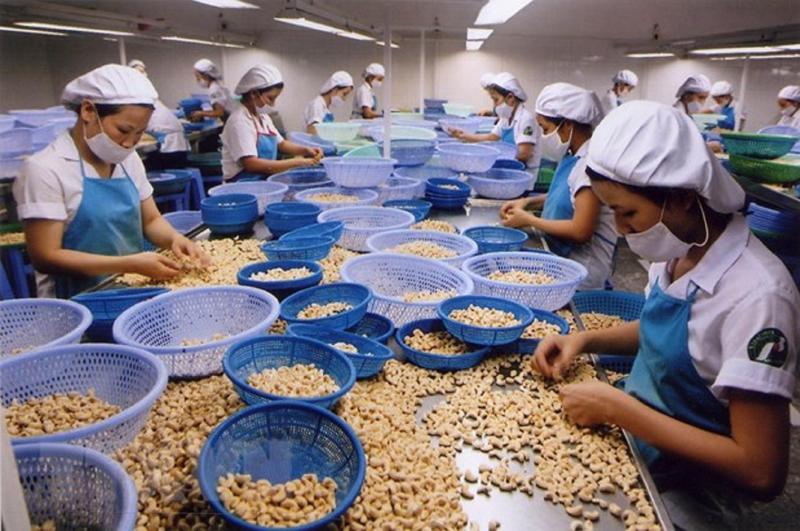
Mr. Bach Khanh Nhut, Vice Chairman of the Vietnam Cashew Association, said that after more than 40 years of establishment and development, Vietnam's cashew industry has made great strides. From tinkering with foreign cashew processing equipment and technology, it has now become the country that owns the technology and is the world leader in cashew kernel exports, accounting for more than 75% of the world's cashew kernel exports.
"The success of the cashew industry is to have modern processing technology, machinery, and equipment with superior and effective technology lines, helping to increase productivity, save raw materials, reduce costs, and meet the requirements of international customers," Mr. Nhut commented.
However, besides favorable factors, the cashew industry still faces many challenges. Most cashew processing enterprises are not proactive in raw material sources; The supply of raw cashew nuts only meets about 30% of the province's processing capacity, while 70% of raw cashew nut materials depend on imported supplies from Indonesia, Cambodia, and Africa. The connection between businesses and farmers in the production-processing-business chain is not tight; Many cashew processing facilities are on a very small scale and have limited financial potential.
"A paradox is that while Vietnam is the world's largest exporter of cashew kernels, in recent years, the amount of cashew kernels imported into Vietnam to do a few extra steps and then exported has increased rapidly. This is the consequence of allowing the import of cashew kernels into Vietnam without applying measures to protect the domestic cashew processing industry," Mr. Nhut emphasized.
A "prominent" problem of the cashew industry is that in the past few years, businesses exporting cashew nuts and pepper have continuously encountered fraud incidents. According to the Vietnam Cashew Association, normally when exporting, businesses must make transactions via LC (letter of credit payment). This is a transaction that ensures safety, because the buyer is responsible for asking the bank to sign a letter of credit to commit to payment to the seller. After the LC is issued, the importer must deposit 100% of the value or a corresponding amount at a specific time to ensure the exporter is paid according to the contract.
However, cashew export businesses face difficulties because partners often trade in large quantities and do not want to coordinate transactions and deposits. Many businesses accept signing contracts without needing a escrow partner, but entrusting the bank in the importing partner's country to receive payment, then handing over the shipment documents to the partner to the port to receive the goods. This leads to easy fraud, even when documents go to the buyer's bank, when that bank colludes with the purchasing partner to commit fraud.
The number of fraud cases is increasing, causing great damage to Vietnamese export enterprises. With the current situation, the Vietnam Cashew Association recommends that businesses need to select partners for sales. For new customers, exporters should discuss with the Vietnam Cashew Association to coordinate with the Vietnam trade office in the host country to assess capacity, as well as customer information to ensure it is a safe transaction.
Regarding fundamental and strategic solutions for Vietnam's cashew industry to develop sustainably, according to Mr. Nhut, cashew industry businesses need to shift strongly to deep processing with diverse products, meeting the different needs and tastes of "final consumers".
On the other hand, cashew processing enterprises need to focus on investing in developing raw material areas; Support and sign purchasing contracts with cashew growers to have an unstable source of raw materials. Thereby, reducing dependence on raw material supplies from abroad, improving the competitiveness of our country's cashew processing exports.
Ha Diem HSV