(HSV VIETNAM GROUP) – According to experts, the official export of frozen durian to the Chinese market is expected to create great opportunities for the Vietnamese durian industry. Compared to fresh durian, frozen durian has higher added value and can reach an export turnover of 400 - 500 million USD in 2024.
On the afternoon of August 19, in the presence of General Secretary and President To Lam and General Secretary and President of China Xi Jinping, the Ministry of Agriculture and Rural Development of Vietnam and the General Administration of Customs of China (GACC) signed a Protocol allowing the export of frozen durian to China.
"Increasing the area planted with high quality durian"
According to experts, frozen durian including whole durian (with shell), pureed durian (without shell) and durian rice (without shell) are products with great potential to contribute to agricultural export turnover. The official opening of the Chinese market for this product is expected to create great opportunities for the Vietnamese durian industry.
In 2023, Vietnam will export about 500,000 tons of durian, reaching a turnover of 2.3 billion USD, of which exports to China account for 90%.
Compared to fresh durian, frozen durian has higher added value. The Vietnam Fruit and Vegetable Association expects that frozen durian exports can reach an export turnover of 400 - 500 million USD in 2024.
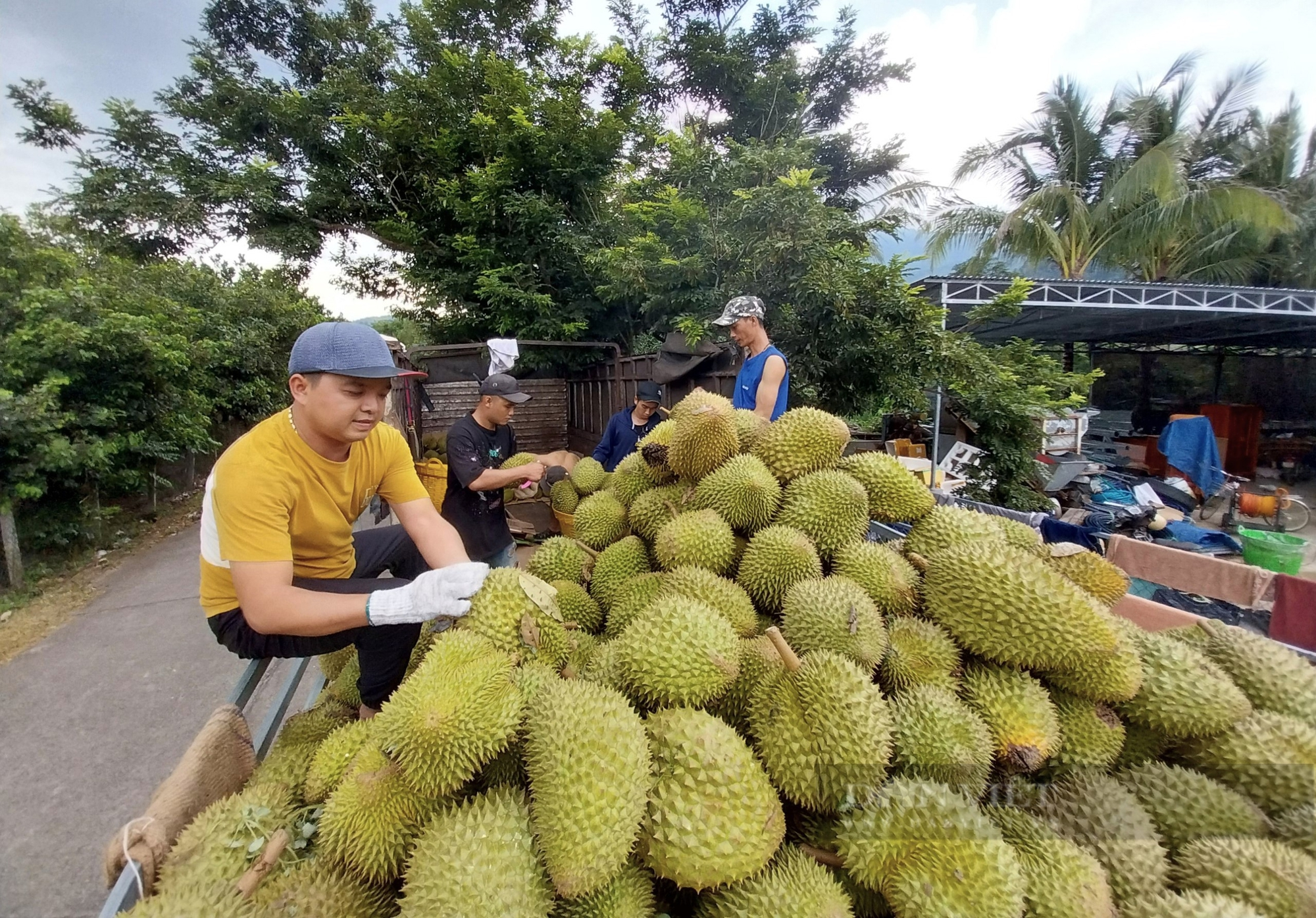
Exporting frozen durian to China: How do businesses comply, what do experts predict in the next 10 years? - Photo 1.
Traders come to buy durian in the highland commune of Phuoc Binh, Ninh Thuan. Photo: Duc Cuong
Regarding this issue, talking to Dan Viet, Mr. Nguyen Quang Hieu, Deputy Director of the Plant Protection Department (Ministry of Agriculture and Rural Development) assessed that signing the Protocol to export frozen durian to the Chinese market helps Vietnam diversify durian products, followed by processing and preservation technology.
"Frozen processed products will support other durian products. Gardeners will focus on producing high quality products for export to foreign countries," Mr. Hieu said.
Previously, from March 2024, the Plant Protection Department sent an official dispatch to localities, requesting to review and synthesize frozen durian growing areas and packaging facilities for export to China.
Accordingly, frozen durian packaging facilities must meet requirements on food hygiene and safety, packaging process, traceability and food hygiene and safety control process (HACCP). Along with that are some requirements for freezing and cold storage capacity.
According to Mr. Hieu, since Vietnam exported durian to China, the General Department of Customs of China has issued more than 700 growing area codes and nearly 200 packaging facilities. However, the durian growing area that has been granted a code only reaches 25,000 hectares out of a total of 150,000 hectares.
"In the coming time, we will ask the Chinese side to expand the growing areas with codes, increasing the area for growing high-quality durian," Mr. Hieu shared.
According to Mr. Hieu, to effectively exploit the Chinese market, it is time to focus on durian quality, raise people's awareness, including effectively managing the quality of issued codes. Localities must also think about monitoring growing areas. This comes from businesses and localities, requiring coordination from central and local management agencies.
"I think that improving product quality will be more sustainable than developing durian growing areas massively but without quality. At the same time, it is necessary to build a clear traceability system. This also requires the coordination of businesses and localities," Mr. Hieu emphasized.
Mr. Nguyen Thanh Binh, Chairman of the Vietnam Fruit and Vegetable Association, shared that frozen durian has so far been mainly exported to Thailand and some distant markets such as the United States and Europe... According to Mr. Binh, the demand for frozen durian in China is huge. Therefore, when officially exported to this market, Vietnam's frozen durian exports can increase even more by 2025.
Business is ready
From the perspective of export businesses, Mr. Truong Viet Thang, Director of Toan Thang Trading Import-Export Co., Ltd. (Dong Nai province) said that the company is ready to export frozen durian to the Chinese market.
"Investing in a factory to export frozen durian requires 5 times more capital than a warehouse for fresh packaged durian, so the number of businesses participating will be less, and competition may be less fierce than with fresh durian. China currently develops a lot of products processed from durian, so it needs a large source of raw materials. This segment is also more stable than fresh durian thanks to its preservation for up to 2 years," Mr. Thang assessed.
Also according to Mr. Thang, frozen durian mainly focuses on the quality of rice, does not require external design like fresh products, so Vietnam can export about 30% more output, bringing great economic value. However, because durian prices have now peaked, even if we open more frozen products, durian is unlikely to increase prices further and will mainly stabilize output. "If durian prices increase further, it will exceed consumers' ability to pay," Mr. Thang said.
According to Dr. Luong Ngoc Trung Lap, agricultural market analyst, said China is the main consumer market for Vietnamese durian fruit, with very high demand. "The Chinese market is still very large, so expanding production in the near future, at least in the next 5-10 years, is not a concern," he assessed.
However, according to Mr. Lap, after 10 years, there will likely be many changes in the market. Because, when the Chinese market demand is large, people love durian fruit. Even though at times the price in the garden is up to 170,000 VND/kg, they still have demand, so many countries will also develop to compete.
"When the Chinese market has such high demand, countries competing with Vietnam such as Malaysia, Cambodia, and the Philippines will certainly find ways to penetrate this market," Mr. Lap cited and said that, with Cambodia and Laos, the area that can be developed is still very large, so the Chinese have come to cooperate in production and bring durian fruits to supply to the Chinese market.
Ha Diem HSV